This is how it feels to be Oldham: Joe Royle’s 1989–1990 Madchester-Era Side

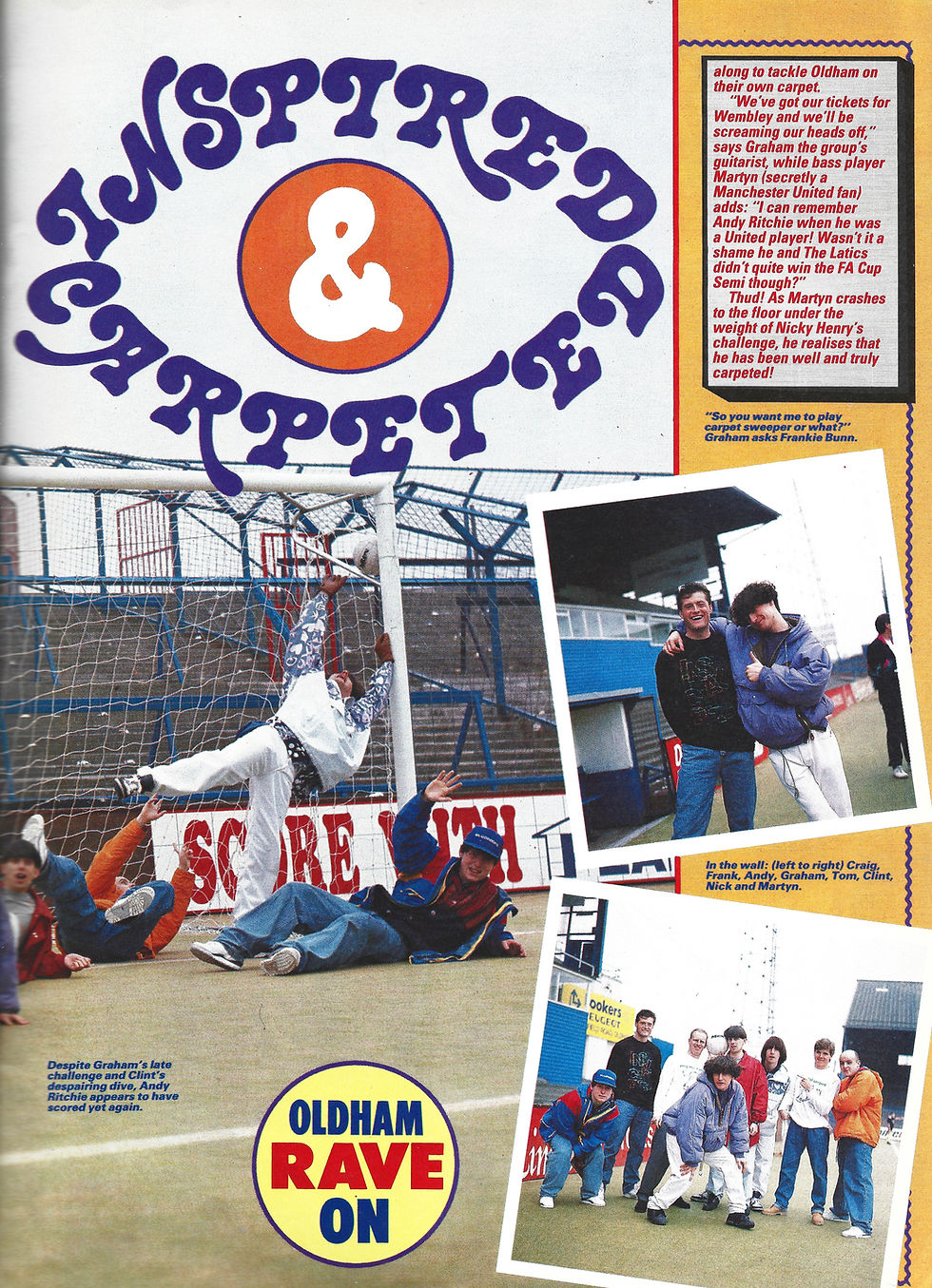
Sometimes planets just align. Unlikely though it seems, in March 1990 British football magazine Shoot managed to find genuine reason for a photo spread featuring members of the Inspiral Carpets and Oldham Athletic players larking around on Boundary Park’s sacred astroturf.
Both were enjoying unusual levels of national attention at the time.
The Oldham-based Inspirals were fresh from their breakthrough single This Is How It Feels, which was riding the Madchester wave at number 14 in the UK charts. Oldham Athletic meanwhile were preparing to play Nottingham Forest in their first – and only – Wembley cup final in April.
The feature itself had all the hallmarks of a “headline first, worry about the content later” idea – not least because the band members did not all support Oldham. In fairness ‘Inspired & Carpeted’ is a headline which nearly works, without standing up to close scrutiny. What dressing Andy Ritchie and Nick Henry up in their best baggies brought to the party is less clear.
Source: Miles McClagan | Flickr
It was not an isolated Oldham moment in the national limelight.
Winger Rick Holden appeared as a guest on BBC prime-time quiz A Question of Sport in April 1990 (during the Bill Beaumont/Ian Botham captains era and before they dropped the ‘A’ for those who care). It marked a rare appearance by a footballer from a second-tier club, though Wolves and England striker Steve Bull would also do so the following year.
Bizarrely, it means Holden has appeared on Question of Sport as often as Liverpool and England captain Stephen Gerrard and Countdown host Richard Whiteley, though 25 times less than Peter Reid - who IMDB shows as the non-captain footballer to make the most appearance on the show (both as guest and mystery guest).
It left them needing to win their last four games to reach the play-offs, a task made even harder by having to play the games every other day over the first week in May
On the one hand
, the exposure showed the extent to which the exploits of unfancied Oldham gripped the nation during what was dubbed their “pinch-me” season. On the other, it is surprising the players found the time.
The Littlewoods Cup Final was one of 65 games that Oldham played that season, of which Holden played in 64 of them.
He was not alone. Defender Earl Barrett played in all Oldham’s 46 Division 2 matches, nine FA Cup ties, nine Littlewoods Cup matches and one Full Member Cup tie that season. Fellow defenders Andy Barlow and Denis Irwin managed 62 and 60 games respectively, midfielders Mike Milligan and Henry clocked up 60 and 59 appearances and striker Roger Palmer 58.
That reflects a relatively small squad which carried Oldham through to the business end of three competitions. Seven of the 23 players used that year played less than 10 games, meaning the burden was carried by a core of 16 players.
Oldham’s squad, which largely comprised players cast off from clubs along the M62 motorway, was put together by Joe Royle. He had been in charge since 1982, but aside from a third-place finish in 1987, Oldham had shown little sign of making a splash until this season.
But something was about to click. Maybe it was the youthful enthusiasm of the likes Barrett, Henry and Paul Warhurst, teaming up with the wise heads up front of Roger Palmer and Andy Ritchie. Maybe it was the arrival of Holden, whose crossing created endless chances as they embarked on a run through the cup competitions. Or maybe it was their plastic pitch.
Oldham were one of a handful of English clubs playing on artificial pitches during the 1980s – alongside Queens Park Rangers, Luton Town and Preston North End. This certainly gave these teams an advantage, at least as far as managers and players from visiting sides were concerned.

Source: Miles McClagan | Flickr
While the plastic pitch had hardly made Oldham invincible in the previous two seasons – they were beaten nine times at Boundary Park in the league across those years – it is difficult to argue it did not contribute in 1989-90. Oldham lost just once at home in the league all season. By contrast they lost a dozen times – more than half their away games in the league. They also won nine out of 10 of their home cup ties.
And it was their swashbuckling cup exploits which stole the headlines. This was evident as early as the second round of the Littlewoods Cup when Frankie Bunn scored six of the goals in a 7-0 thrashing of Scarborough – which remains a League Cup record.
The other goal scorer that night was Ritchie, who would score in every League Cup game – including replays and a 3-1 third round win over Arsenal - until Oldham lost 3-0 in the semi-final second leg at West Ham. Under normal circumstances such a result would end, or at the very least, put the cup run in jeopardy. But Oldham had essentially already sealed their place in the final by thrashing West Ham - who were also a second-tier side at the time – 6-0 at Boundary Park in the first leg.
At the same time Oldham were also making progress through the FA Cup. They had already knocked out Birmingham City and Brighton before overcoming Everton in a second replay. A 3-0 quarter-final win put paid to Aston Villa, who under Graham Taylor were running Liverpool close for the title, and set up a second major cup semi-final – this time against local giants Manchester United.
However, their success was stretching the squad. Across two months from 7 March to 7 May, Oldham played 21 games – including three cup semi-finals and one cup final. That amounts to a game at least every three days.
Bizarrely, it means Holden has appeared on Question of Sport as often as Liverpool and England captain Stephen Gerrard and Countdown host Richard Whiteley
Oldham squeezed six games into three and a half weeks between their FA Cup quarter-final win and semi-final against Man United, where they compounded their fixture congestion by earning a replay thanks to Palmer’s extra-time equaliser.
That game added to their reputation as Oldham took their place in the greatest day of television British football, playing out a 3-3 draw just hours after Crystal Palace had stunned TV viewers and Liverpool alike by beating the cup favourites 4-3.
Oldham pushed United to extra-time in the replay three days later before finally losing – ending the unlikely dream of a second-tier side making both domestic up finals. And that reality check seemed to take the wind out of Oldham’s sails. At the end of the month they lost to Nigel Jemson’s winner against Nottingham Forest in the Littlewoods Cup final, by which time Oldham’s play-off hopes were also derailed.
Oldham had lost six out of eight league games from late March to the end of April. It left them needing to win their last four games to reach the play-offs, a task made even harder by having to play the games every other day over the first week in May.
Though they fell short, Oldham would be promoted the following season and go to enjoy three seasons in the top-flight before another FA Cup semi-final defeat to Manchester United broke not only Oldham hearts, but also their spirits.
Oldham were relegated in 1994, Royle left that November and the Inspiral Carpets split up in 1995.
How We Ranked Them
We have five categories of greatness from our five-star All-Time Greats category at the top to our one-star Blinkered Greats category at the bottom. Fittingly for a second-tier side that so nearly achieved across three different competitions, we ranked Oldham as ** Edge of Greatness
Listen To The Podcast
We were joined by Evertonian Declan Clark to explore the Everton connections as Royle’s Oldham took on their pinch=me season.

There was little hope for Oldham as they at the start of May dragged their weary bodies into the first of four must-win matches in a week. Fortunately, up first was Oxford United, a side that had managed to concede seven goals on Luton’s plastic pitch two years previously. Sure enough, Oxford obliged, keeping Oldham’s dream alive by losing 4-1.


Comments